For reference: https://www.calcmaps.com/map-distance/ https://2e.aonprd.com/Rules.aspx?ID=2580
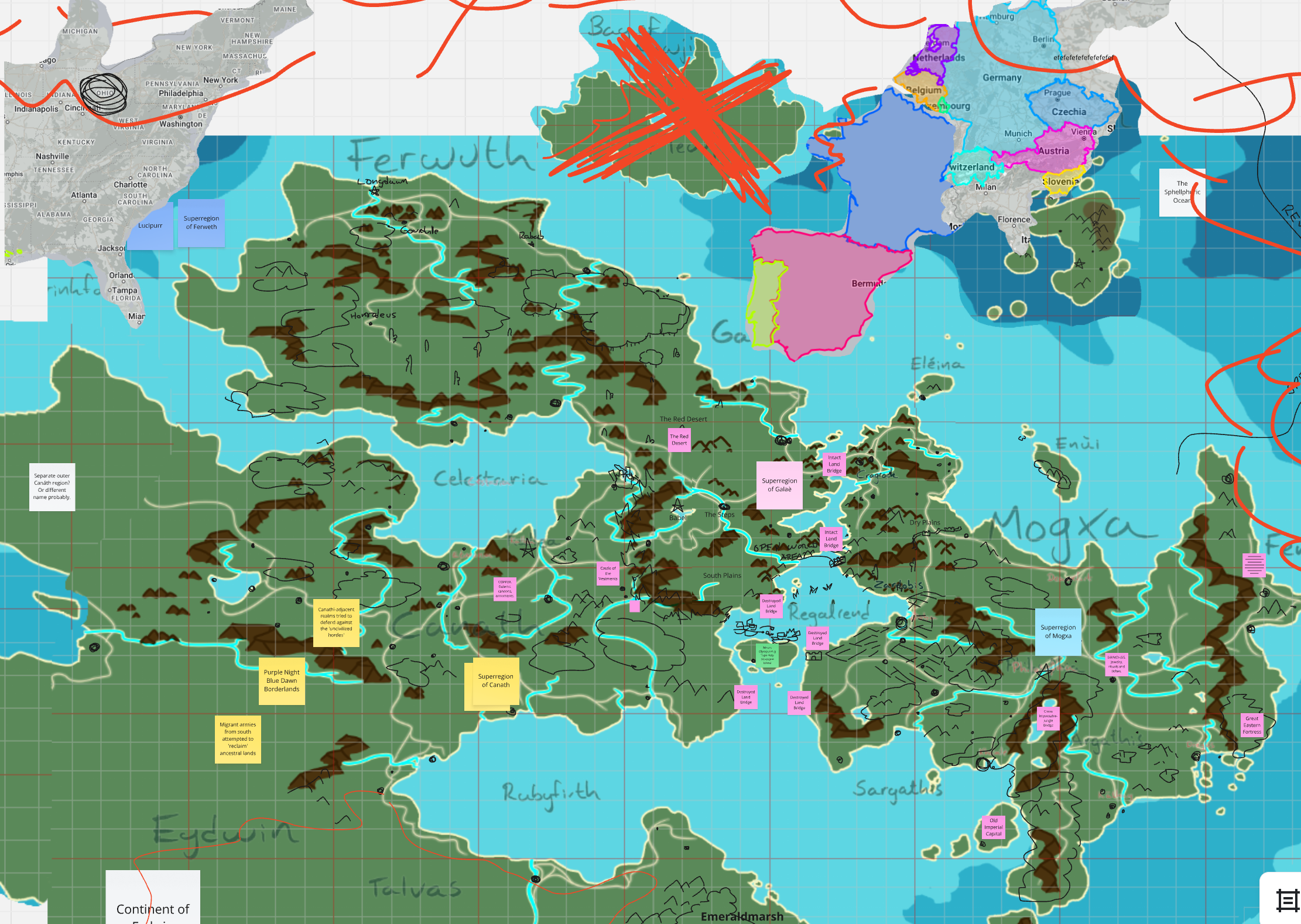
Now, the scale of Vendrith has not been totally consistent, nor should we expect it to. There’s a lot of hassle involved in keeping that exact, and the maps may essentially need certain adjustments to scale to make it work as best as possible for actual play.
However, we should still at least try to keep it within a certain range of itself.
A party speed of 25 lets you move 20 miles per day. I’ve included the walking travel time using this in each example, though this assumes they’re on a road the entire time (lack of road or even a rough road through woods, mountain passes or cliffs means difficult terrain). I’ve also included sailing speeds AT SLOWEST 60 miles per day, though realistically closer to 96.
This means that the west to east end of Galae is about 600 miles (30 days walk). The islands of Vilhun are similarly spaced at most a little over 600 miles apart (6-10 days sailing). The farthest corners of Ferweth are about 750 miles (37 days walk, though realistically with difficult terrain all over it’d be closer to 75 days). Encanath is over 1200 miles wide (60 days walk on a good road). Bottom of Mogxan Sergetis to top of Ennui of Mogxa is also about 1200 miles. At least a 333 mile voyage separates Mogxa and Lorgun (3 and a half to 5 and a half days sailing). A little less than that, about 280, separates Mogxa and Veducia at its farthest (about 3 days till 5 days sailing). The farthest voyage north-south on the Celene is about 300 miles (little over 3 days on any good ship). The voyage from Singsong to Horiza might take 20 days under ideal circumstances, but in reality takes between 40-60 due to the crawling speeds required to navigate the fog.
These land travels all also assume minimal breaks, never staying anywhere longer than just to rest.
A land courier (runner) with a run speed of 40 speed can move about 32 miles per day leisurely, but also easily double that (64 miles per day) by resting only minimally but becoming fatigued. They can usually ignore difficult terrain due to their training. The best trained couriers can run as if their speed was 60 feet, allowing them to travel 96 miles per day, though this is only used for highly urgent messages.
Long-distance magical communication exists, but 1) there are fears that it can be intercepted or will fail to reach, and 2) the presence of the World Fleece definitively and greatly increases the risk of failure to deliver.