Click here to return to the index.
Note
Note: We use the term homebrew to refer to ‘content’ such as player options, and houserules to refer to changes to rules.
Houserules
Common Houserules.
These are Houserules that are active in multiple, if not all, campaigns.
- Modified Aid. Also known as Friedport Aid. The DC is 20 again instead of 15, but the tiers of success are more favourable. Critical success gives +3, success gives +2, failure gives a +1 instead of nothing, but a critical failure still gives a -1. Being a Master in the skill increases each tiers bonus by 1, including nullifying critical failure into doing nothing.
- Godpowder vs Redpowder. If a character has firearms, with the exception of air guns, they ought to be a Titan worshipper of some sort. This will grant them access to crafting and using godpowder (ammunition) and firearms as usual. Others who pick up a Titan-Worshippers firearm cannot create new godpowder for it (and usually cannot buy it, as they lack a good source). They can still use it for the amount remaining, but the Firearm is capable of Misfiring, which you have to roll a DC 5 flat check for after you miss with it. You may also incur a deity’s wrath for using a stolen gun. A character can have access to a worse version of firearms even as a non-religious person, using the alchemical by-product called Redpowder. These firearms can also misfire like above, but only after a Critical Miss. No amount of maintenance will remove these flat checks.
- Backstory Lore. In addition to the Lore training granted by your background, you get training in another Lore relevant to your character’s backstory, decided in concord with the GM.
- Scaling Lores. The lores you gain from your Background, and from the Backstory Lore if active, are gained as the “Additional Lore” skill feat. This means they automatically scale to Expert at level 3, Master at level 7 and Legendary at level 13.
- Student of Lore. Using a skill training to get a lore gives it to you as the “Additional Lore” skill feat. See above.
- Premaster Clarifications. The remaster Pathfinder 2e has set some new standards, but not all content has been re-printed or errata’d to use them yet. Here’s some clarifications: Talismans no longer have a Skill Proficiency prerequisite - if you see one with it, you can ignore it.
- Crafting Clarifications. We use the remastered (but not complex) crafting rules, where setup is 2 days normally but 1 day with a formula. Elements of downtime crafting events and critical crafting may make appearances if the GM desires. In addition, there’s a new feat called Rushed Setup that replaces Quick Setup. Rushed Setup opens the avenue for crafted items receiving Item Quirks (GM may use their own table or decide on a quirk).
- Plentiful Deities. Vendrith deities have cleric spells for every rank 1-9th, instead of only three spells.
- Weapons Drawn? More of a clarification on assumptions than a houserule. We do not assume you start with your weapons drawn in every encounter. Your character can be expected to wield their weapon ahead of time when in a dangerous environment or situation, but not just about whenever. If you are caught by surprise or in a place where wielding a weapon isn’t kosher, you’ll have to spend actions to draw your weapon. This goes both ways though - catch enemies by surprise and they’ll have to draw theirs!
- Guns Loaded? You can keep a gun pre-loaded with ammunition even when holstered (don’t try this at home). We usually allow this with crossbows too. You can always keep your weapons with ammunition loaded if you’re in a weapons drawn type situation, as above.
Possible Houserules
- Feats+ Basic Pack. Avoided in campaigns with completely new players, but commonly used otherwise. Can also be added later on. Adds a slight bit more options for character building without going all the way of Free Archetype. Gain a bonus Level 1 Class Feat and General Feat, as well as a Level 2 Class Feat when you reach it!
The Level 2 Class Feat is often useful for taking an Archetype, which is an option to consider if you want a more specific, complex or multi-faceted character.
- Vendrith Booster Pack. A follow-up to the Basic Pack that campaigns which reach level 10+ may use. Gives a bonus level 10 Class Feat, and Level 11 General Feat.
The Vendrith Booster Pack is likely the last bonus feats you get, 5 is already a lot! Campaigns may also choose to leave out one or both in case they want to give out Bonus Feats as rewards from plot points, and the GM thinks it may create too much combined with the packs.
- Natural Pack. Was available in Hunts of Vilhun. All ancestries gain access to the versatile human heritage and the natural ambition human feat in addition to their normal feats. Humans can choose one ancestry other than their own instead of gaining a heritage. They gain access to that ancestries’ feats 1st-level feats in addition to their own feats.
- Caster Level Incapacitation.* The Incapacitation trait only improves failures and scales off of casters level, rather than spell rank.
- Stronger Incapacitation. The Incapacitation trait only makes creatures above the required threshold immune to critically failing, only upping that result to a failure instead.
- Essence Magic.
- Stamina.
- Quick Draw, Not Quick Release. When using Quick Draw, you can also put a weapon away as part of the interact action to draw a new weapon. Active in the Vilhun campaign.
- Hero Point uses. The few uses of hero points may be modified in a campaign, or added to. In the Landcrab Plot, the uses were: 1 Hero Point can be spent to Re-Roll a check. This can result in a worse outcome. 2 Hero Points can be spent while dying to either stabilize or regain 1 HP. 3 Hero Points can be spent for a hint that would drive the story forward. This can be paid collectively!
- Hero Point sources. Hero Points can be gained from a variety of sources like fulfilling in-game objectives, but we usually add some more consistent “meta” sources as well. In the Landcrab Plot, this was spelled out as: You start each session with 1 hero point. One player gains 1 for doing the recap. One player gains 1 from the “heroic star”. One player gains 1 at break-time, choose between yourselves during the break. More can be earned through play when you complete medium and long-term objectives, and other types of play worthy of reward.
- Soften Blow. If you hit a would-be lethal attack, you can use a Reaction to retroactively make it nonlethal (with the attack penalty). Spell attack rolls can also be made nonlethal with no feat required, though with the -2 circumstance penalty as for normal weapon attacks.
- Downed but not Out. When you gain the Dying condition you may remain nominally conscious for roleplay (unless specifically knocked out by the enemy). You still gain all other drawbacks of the Dying and Unconscious conditions, and can’t act (your mind too cloudy to even Recall Knowledge). If you would die, you may get some last words in.
- Support Moves - call in special support actions in boss fights from allies you’ve earned.
- Crews - smaller and more coordinated than a troop, a crew is four enemies working together as one.
- Boss Actions - actions that certain monsters have, which have a tell and a way to be either stopped or mitigated. The action is taken on one turn, and then the main effect doesn’t happen until the monster’s next turn. Untested how it would interact with Boss Monsters with multiple turns.
- Guide Books. Finding a tome on a certain topic can provide an item bonus to downtime activities relevant to the book, for activities in which consulting a book throughout is possible and convenient. The Item Bonus can easily be at least 1 over what general items of the party’s level can get due to its specificity, like an early game book offering a +2 bonus to crafting a certain item or set of items, or an invaluable ancient tome giving a +4.
- Formula Schematics. Formulas can be found as loot called Schematics, just as they can be bought. A character can learn it by spending downtime with it if it is an item they could craft, but the item doesn’t just disappear when it does (even if that would be convenient game design). The schematic can be sold as a treasure item for full value (GM’s need to consider it as part of the loot value they give out). Creating a copy of a formula is possible, but uses the rules for Crafting and the Earn Income table, as no formula is a simple schematic.
- Crafting Lores. Potentially more of a clarification than a homebrew. So long as you meet the prerequisites in Crafting to Craft an item otherwise, you can use a Lore like “Glassmaking” to craft said item, gaining a reduction in the DC for it. Lores like “Blacksmithing,” “Alchemy,” “Magical Crafting,” “Clockwork” are so broad and broadly useful it can only ever give a -2 DC. Specific Crafting Lores like the rest found in Specialty Crafting and similar are specific and niche enough they can give the full -5 DC. If only a component of the item being crafted makes use of the specific lore, the GM may give you half the DC reduction (5→2, 2→1).
This allows you to specialise your Crafter a bit more. Also stacks neatly with the Specialty Crafting feat itself.
- Hunlords and House Spirits.
- Mooks. Weaker creatures that need to fight in numbers to matter, usually alongside a stronger leader. Have only 2 actions.
- Mook Nexuses. Spawns mooks over time.
- Boss Monsters with multiple turns.
- Resonance.
- Levelling Items.
- Battlezoo Monster Carving & Crafting.
- Reworked Materials.
- Weapon and Armour Maintenance.
- Raid Zones.
- Auction Houses.
- Rune-Presses.
- Alchemical Cocktails. Gain access to the benefits of an alchemical item, cheaper and gained from staying at an inn, but can only be used the following day.
The cocktails from the Merry Clove are special mutagen-like cocktails that are enjoyed at the bar but don’t take effect immediately, for which you’re then given a bottlecap to remember the aroma by. Drawing and activating the bottlecap works exactly as using a potion does normally, except you need to be able to smell and you aren’t prevented from using it by Sickened.
- Sieges.
- Bases.
Houserules in Progress
In need of finishing, testing and/or a rework.
- Riskier Firearms. Firearms may be made more of a gamble to use, to increase their potential threat level and relevance as a major plot-point of the setting. They gain the Risky trait. [Risky] Gain an additional damage die as a baseline (this doesn’t increase the amount you gain from striking runes, which still only add 1 extra per tier). If it has the Kickback trait, it deals 2 additional damage instead of 1. If it has the Deadly or Fatal trait, each adds 1 more damage die than usual on a critical hit. If it has Scatter, the damage dealt is 1 point plus 1 for every damage die. As a trade-off, the weapon can always misfire , which you have to roll a DC 5 flat check for on a Critical Failure. If you have a Redpowder Weapon or a stolen Titan-Worshipper’s firearm as a non-worshipper, you have to roll on a failure as well.
A GM can also introduce a Risky firearm as just a special version of an item, instead of as a whole rule. This might be a way to play-test the rule.
- Rogues use Backstabber. The existence of the Backstabber trait has always been cool, but disappointing since Rogues and Investigators usually bypass it through their already existing precision damages. This rule would make Backstabber increase precision damage by 1 (or 2 when a +3 weapon) if applicable.
- Slow Healing. Splits healing into 3 types - circumstance (medicine skill treatment), status (magic) and item (alchemical and consumable). When you get healed for one type, you gain it as a condition whose number of healing you note down. If you were to get healed for the same type again, you subtract the amount of healing from the source you already had, essentially only allowing you to “increase” the amount gained and not “add” to it. Whatever new source of healing you overrides your condition. This means you can only be healed so much from each type before you need downtime to start a fresh. The conditions are removed either during a Rest or during a Safe Rest, which can only be done in a town or otherwise safe base (but not while travelling). Consistent Healing. Intended for Slow Healing but can be used without it. All healing sources have their dice taken out of them and are turned into a flat number instead, usually their average. Allows for more consistency and simplifying the process of healing over a number of days, and reduces re-rolling to try to get better results (and being disappointed when it’s wasted). Consumable Healing Doubled. For Slow Healing and Consistent Healing. To make consumable healing items more worthwhile when they can’t be used again and again. Consumable healing items with die involved give maximum healing. Overhealing. For Slow Healing. Meant to to make limited healing not potentially “wasted” if done while at high health (or stamina if using simple stamina as below), incentivising use early on instead of when already grievously injured. If you receive healing that takes you up to max HP (and stamina), you only list the amount of healing up to reach that number as your condition. However if the healing source was status or item, the points that went above that you receive as Temporary Hit Points that last 1 round. Others? For Slow Healing. Hero Points may allow for taking the action Second Wind.
- Simple Stamina. Intended for Slow Healing, but can be used standalone too. Stamina except there is no resource involved, you can just always recover half of your health. In addition, things that heal Hit Points can also heal Stamina, starting by filling out your HP and then the rest covering Stamina.
- Clearer Quest Rewards.
Better Consumables? While PF2e has a lot going for it in terms of item balance making for a better game, particularly from the GM’s burden side of things when compared to 5e, I still think the ultimate balance they went for to have some underwhelming game design/user behaviour implications at times. An issue I desire to solve is this: players so rarely use their consumables. There’s a number of things at play here all at once, some of which is just psychology, but I think it can be improved on a step-by-step basis by testing various variables. For one, the least intrusive, is for GMs to just give out higher levelled consumables. A heuristic trick I’ve found for Treasure by Level is that you can turn giving out 2 level-x rewards in favour of 1 reward that is level-x+2. If you check the Building Items item price tables 2-19 and 2-20 you’ll see that in terms of value that roughly lines up. Thus, you can skip giving out 2x level 1 healing potions in favour of one level 3 healing potion to a level 2 party, whom would get much more out of the actions spent on that higher level consumable. I don’t find this to be enough however, and thus below I propose some houserule ideas that may take it further.
- Use-or-Lose Consumables. Either actual expiration dates (from wildly-harvested stuff, or even from store-bought or crafted); OR a guild-quest system where you’re granted consumables to deal with a quest BUT have to turn in ones remaining afterwards (ties in neatly with Clearer Quest Rewards). They’re covered with a magical tag/seal which the guild can ‘connect to’ with a ritual to check whether the items have been used or not, which they do when a quest reward is to be collected. Any consumables you don’t turn in have their costs subtracted from the quest reward.
- Bulk Rebalance. I think carrying capacity doesn’t come into play enough, and I think you can carry way too much junk items, and especially consumables, that you then end up never using. I propose making basically all consumables cost 1 bulk carrying capacity, and replacing the negligible bulk category with L bulk instead (and just calling it 0.1 bulk). Coins get to stay as they are (1000 coins = 1 bulk) UNLESS a currency rebalance also is in play - at which point it might be 100 coins = 1 bulk. Consumable heavy classes would probably get something to make sure they’re not too badly affected, either temporary items get to stay L bulk or the Alchemist class and such get a feature/general feat that allows them to be more effective with consumables’ bulk.
- Currency Rebalance. Basically I hate that only Gold Pieces matter, even at level 1. Also if adventurers can pay for a peasant’s family for the rest of their lives with the leftover change of a consumable item they’re buying, even at lower levels, the socio-economic inequality because so ridiculously stark that no adventurer can ever be considered a moral person. Unlikely to do anything with this though unless there is a particularly elegant way to do it without individually repricing the entire existing catalogue and future items to be released.
Scalable Item DCs?
- Node Travel.
- Base Upgrades. Potentially mergable with the ones from that other book.
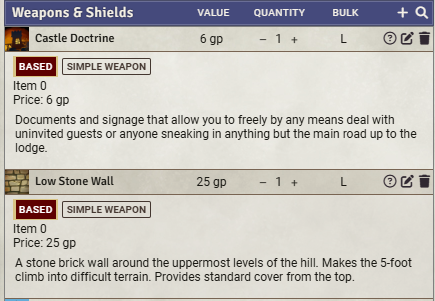
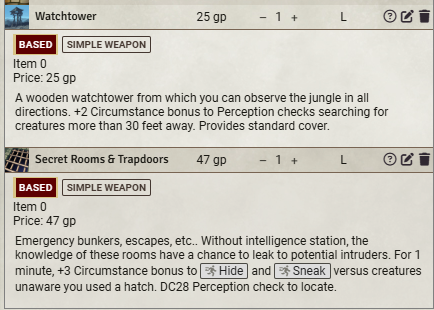
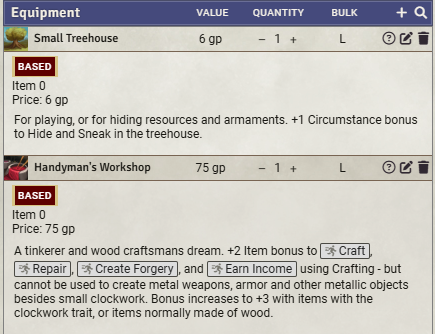
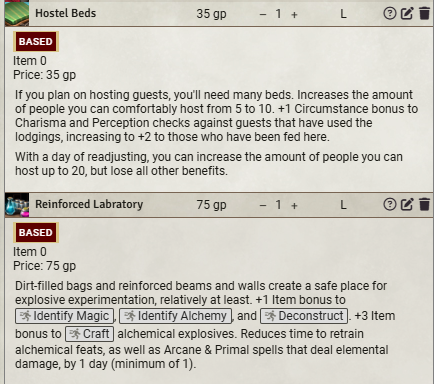
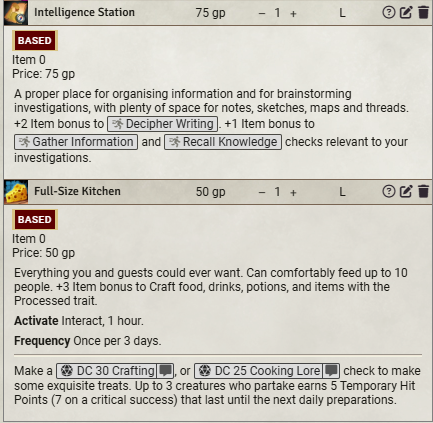
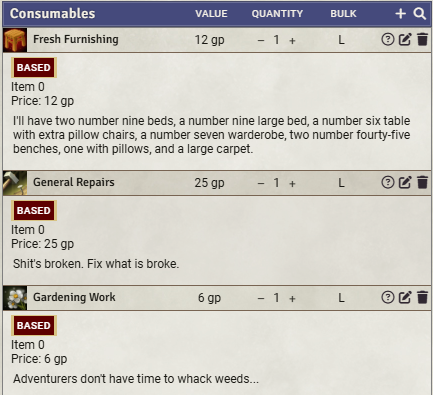
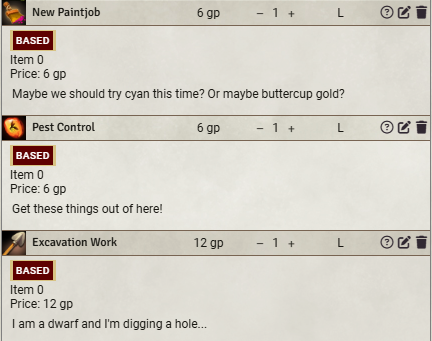
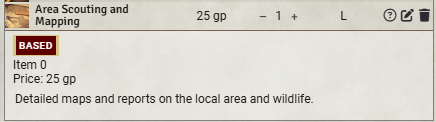
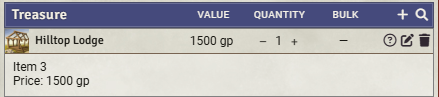
And ones the party never got:
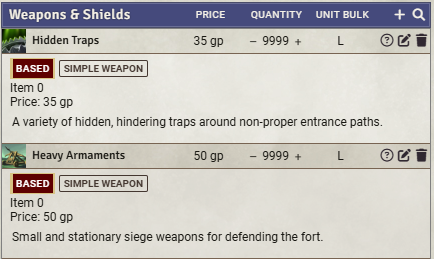
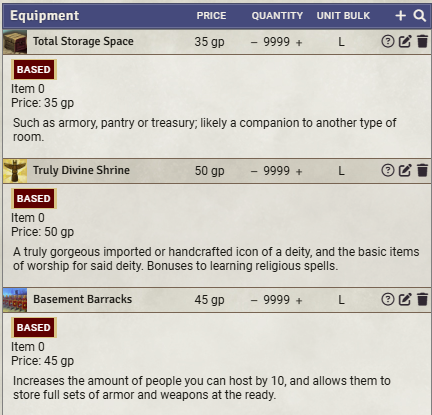
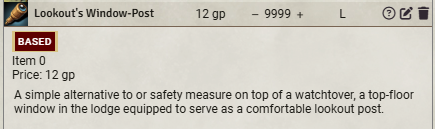
Homebrew
In this house we love team+. You can usually expect their Common content to be confirmed by the GM so long as you ask.
Vendrith Homebrew
The homebrew ‘content’ we have made for Vendrith. Also includes a list of renames or minor changes to existing content.
Subclasses and Archetypes
- Shrieking Frailty. Hybrid study for the Magus, domain of Elianza.
- Crusader Archetype. Might be split into more specific crusader sects, but a general one might be good still. Grant access to Godpowder, Firearms crafting and maintenance, and a limited selection of firearm feats. Grant access to Cleric Spells from your deity through archetype spellcasting.
- Landcrab Archetype.
- Good Doctor’s Disciple Archetype. From making a devil deal with the Good Doctor.
- Fat Tiger’s Pet Archetype. From being bound to serve the Fat Tiger’s interests.
- Construct Beastmaster Archetype - obsolete, Ashur Holdok eventually embraced having his second companion as a Construct Familiar instead of two mutually exclusive companions.
- Twin Duo Archetype. Allows playing as two characters using many mechanics from the Simulacric Spellcraft thesis (Wizards+). Share actions but get access to a special act together, modified based on your class (example below). Shares class abilities and resources. Health is shared, but only the character hit “goes down” when taken to 0 - the other remains at 1 but gains the Fleeing Condition and can only run away or run to try to stabilise the twin. The GM may allow taking feats from the Sniping Duo, Mystic Duo or even Summoner, modified if need be.
Simulacrous Alchemy. Tandem. You and your eidolon perform an action in tandem. Either you or your eidolon use Quick Alchemy, and the other takes a single action. As long as you are within 20 feet of each other, you can freely pass items around as part of these actions, including drawing new items to then pass or use.
Feat Buffs or Reworks
Mainly Skill Feats, a number of which could do with some loving to actually be useful in our (or any) campaigns.
New Skill, Ancestry and other Class Feats
- Project Reality. For Ashur Holdok’s construct companion, allowed it to record its vision into a short film. Inventor-y replacement for Share Senses.
- Rushed Setup. Prerequisite Master in Crafting, level 7 skill feat. You have learned to setup crafting jobs with ease. Your setup time for items is 1 day, or 4 hours with a formula (allowing you to do so during an adventuring day if you have access to your tools and materials). You can choose to increase the Craft DC by +5 to rush even faster, doing the setup in only 4 hours normally, or 2 hours with a formula. If you’re Legendary in Crafting, you can increase the DC by +10 to do the setup in 2 hours normally, or 1 hour with the formula. When you increase the Craft DC by rushing a permanent item, you have to succeed a DC 5 flat check (DC 10 for the legendary rush) or the item gains a quirk.
- Chocolatery. Level 1, requires Crafting. Allows making facsimiles of other items out of chocolate, can be used to deceive others, whom have to roll against your Crafting DC instead of Deception.
- Wired Bomb. Rare level 2 alchemist class feat, additive trait. Requires Chemical Poliorcetica (Alchemists+). When you place or attach a bomb instead of Striking with it, you can arm it with a manual detonation method. Designate a trigger. The bomb no longer detonates from a creature moving through its space or using an action with a manipulate trait on it. If the trigger you designated occurs before the start of your next turn, you can detonate the bomb as a reaction. If a creature was in the bombs space while activated, it takes damage as if you had made a successful Strike with the bomb. Creatures in a 5-foot emanation around the space take the bombs damage with a DC 22 Basic Reflex save against your class DC
- This One’s Got a Fuse! Rare level 6 alchemist class feat, additive 1 trait. Requires Chemical Poliorcetica (Alchemists+). You introduce more combustible material into a bomb that takes time to reach its full saturation. The bomb doesn’t explode on contact. Instead, a fuse will forcibly explode it in its space after 1 to 4 turns, decided by you when you create the bomb. You can have only one bomb affected by this feat at a time. The bomb explodes in a 10-foot burst, and for each round after the first, this radius increases by 10 feet. After two rounds, it explodes in a 20-foot burst, 30-foot burst after three rounds, and 40-foot burst after four rounds. Creatures in the burst take the bombs damage with a DC 22 Basic Reflex save against your class DC. Creatures within 5 feet of the bomb decrease their degree of success by one step lower. A creature adjacent to the bomb can spend an Interact action to attempt to put out the fuse. This normally requires a melee attack or survival check, against the Inventor’s class DC + 4, but the GM can also rule another appropriate action or use of an item applies. On a critical failure, the bomb immediately explodes.
Items
-
Sect Pistol ← Clan Pistol. A pistol that shows allegiance to a specific Crusader Sect, which is considered a great humiliation and disservice to your faith to lose.
-
Invested Holy Symbols: Sun Pendant ← Sun Wheel. Primordial Shepperd Pendant ← Broken Tusk Pendant.
Necklace of Miniature Swords ← Necklace of Knives. Symbol of the Grand Scheme and his infinite armoury.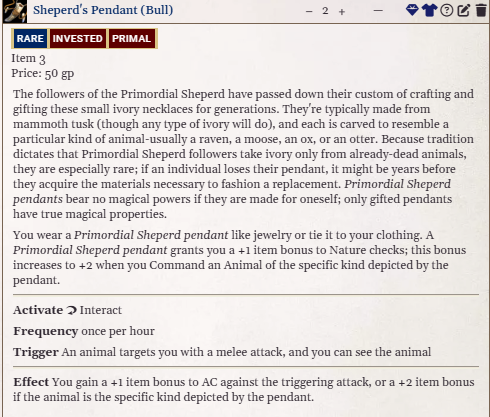
-
Crusader Cult Cards. Similar to cantrip cards, usually comes in packs of 6 and can cast Guidance or Evil Eye (the latter costs 2 cards, as you have to overlay two cards in a specific way to see the eye). The action cost for the latter is 2 and the DC is 17.
-
Old Sea Dog’s Corset. Once a day reduces your wounded by 1 and gives a +2 to your first recovery check, but only works on the salty seas.
-
Shroud of Humanitarianism. Used to shield fallen soldiers until they can receive assistance.
-
Dainty Umbrella. A magic item often carried by Leshys, they are made of bamboo and can slow ones fall.
-
Van and Foggle. In adventures where Stamina (see Houserules & Homebrew) plays a role, these serve as easy ways to regain stamina points. Vanberries restore 1 per berry but give you a -1 circumstance penalty to actions that require precise hand movements for 1 hour. Vanberry juice regains 5 stamina. Enchanted vanberries remove the penalty and recover 2 per berry. A fogglefruit recovers 1d8+2 and a Foggledrink Energiser recovers 2d8+4, but both also give you a -1 circumstance penalty against Sickened for 1 hour.
-
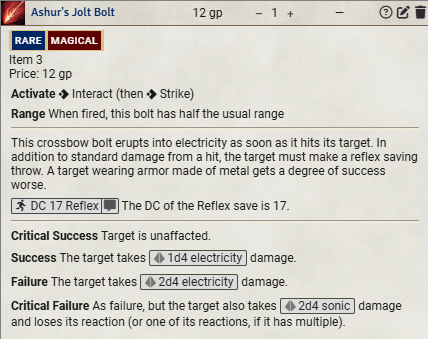
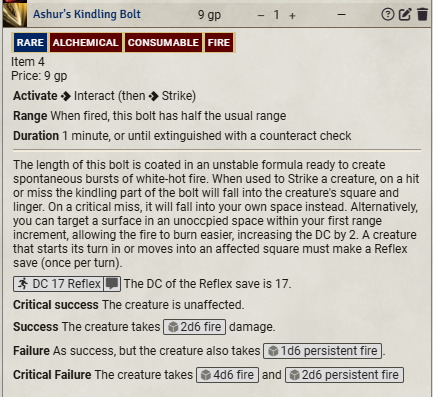
Ashur’s Inventions: He ended up not using these much at all, so we might re-lore them to be someone else’s inventions tbh lmao. Good example of the amount of homebrew I am willing to work with a player to make to fit a character type they wanna play though!
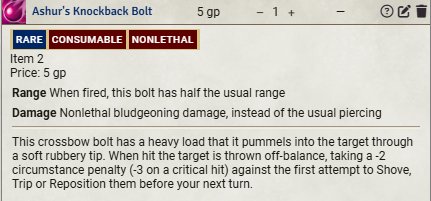
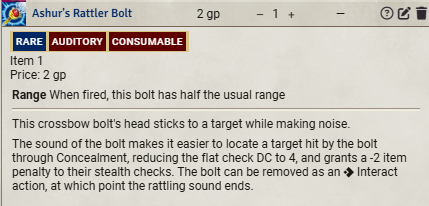
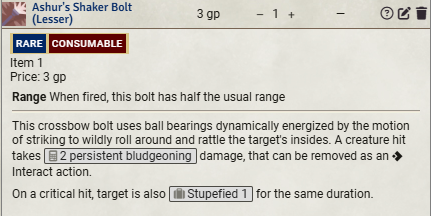
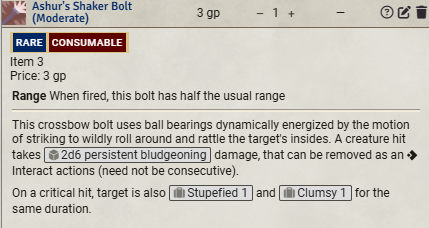
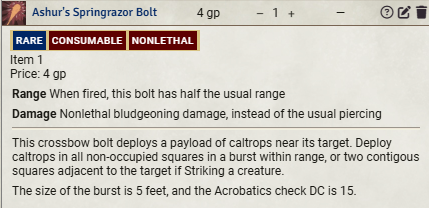
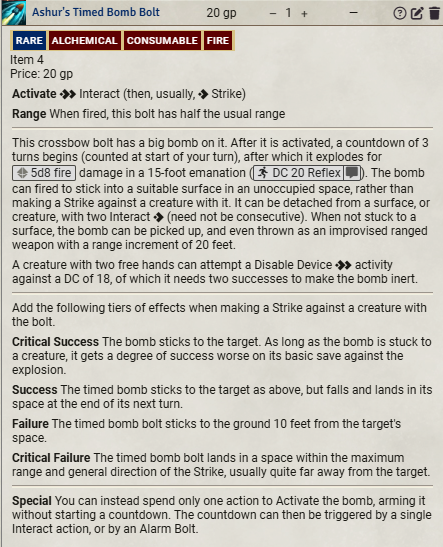
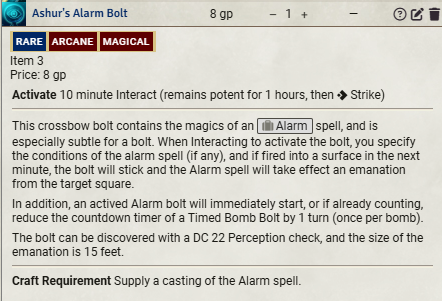
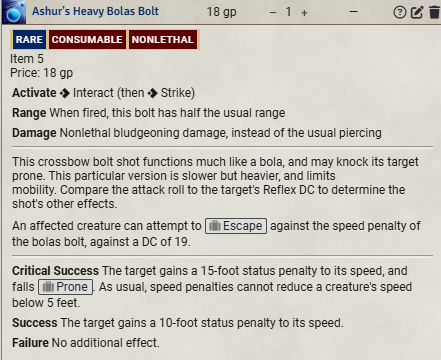
-
Thistlevolt.
-
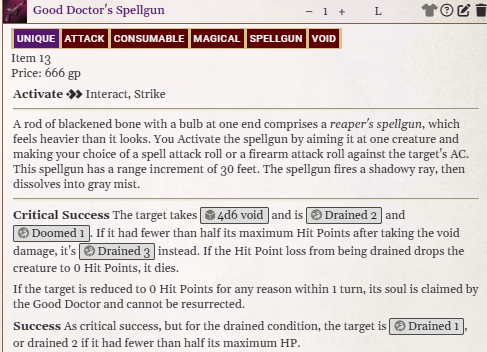
Good Doctor’s Spellgun.
Rituals, Spells and other effects.
- Spiritual Refreshment and Supercharging Ritual. Crusader sect rituals from Veridica that infuse a suitable vessel creature with leyline power, giving an unusually large number of Temporary Hit Points but threatening everyone’s safety if the supercharged character loses these temporary hit points, or worse, goes down and becomes dying.
- Burning on Both Ends. Here for a heroic time, not a long time. You have a +1 or +2 bonus to attack rolls, but are Doomed and have a -1 penalty to AC and saving throws. Intended for temporary characters. Can be modified for saving throw DCs, class DCs, etc.