Galae is a historical region that sits between Ferweth and Canath to its west, and Mogxa to its east. The (absence of a) shared identity of Galae has long been contentious, as has its borders with its neighbouring regions. Galae’s most prestigious period was when the Elven Hightower Civilisation reigned primarily from the Galaen plateau, though it was also a force to be reckoned with during the subsequent “Galaekor period.”
More recently, Galae was devastated by the War Over Haeven and the Eternal Crusade that followed soon after. The Crusaders and Sanitorium have considerable influence over the goings on of Galaen polities, especially those close to their respective homes. Amurrun and Hobgoblins consider Galae their home. Recently, many Kholo have migrated to Galae from the south and now constitutes a large part of the population. Halflings, Dwarves and Elves also form considerable minority populations.
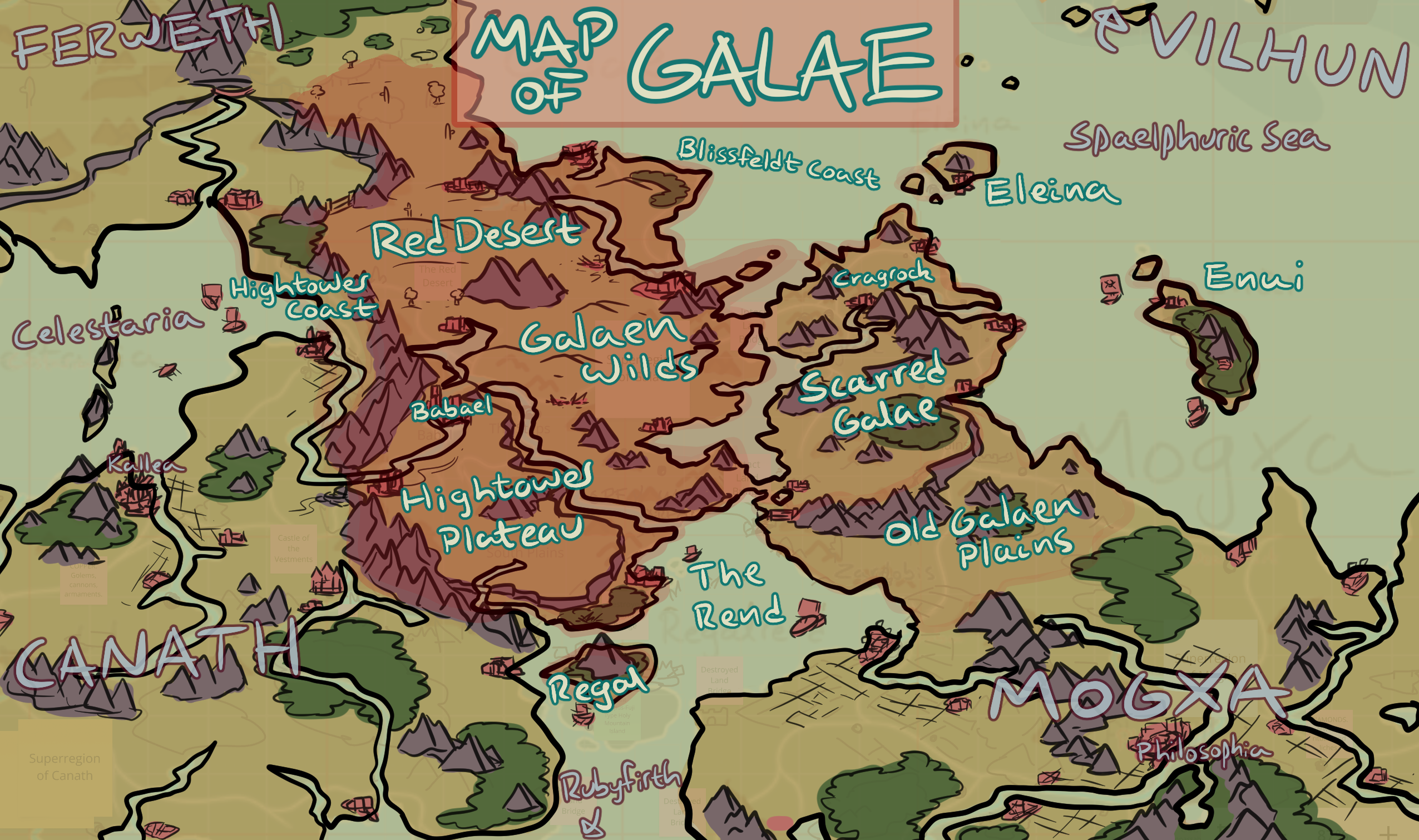
For more in Galae, see galae
Culture
Besides Humans - Amurrun, Hobgoblins and Kholo make up the biggest populations of Galae. Dwarves, Halflings and Orcs also constitute significant minorities. The illusive still-surviving Elves are a rarity across the world, but are perhaps found more frequently in Galae due to their origins there.
Galae is quite linguistically split, with many speaking mutually unintelligible Languages. Galae primarily relies on the Idurian language for politics and commerce, and also often as a way to translate between groups due to the aforementioned division. There is a native Galaen common language called Gaeyli with its roots in the Middle Period - while it largely fell out of favour, it has today seen some efforts to revive it in order to strengthen the ties between parts of Galae.
To modern Galaens, “high” culture and politics is usually seen as foreign and suspicious, or at best wasteful. Loyalty to ones tribe and family are extolled as some of the most important virtues, as are possessing practical talents like athleticism, knowledge around hunting and pastoralism, and all manner of potentially useful crafting. Magic is often considered as something left behind by ones ancestors, and is usually imagined as more powerful the older it is - the re-discovery of artefacts and spells from olden times is therefore a valued occasion.
Roses are plentiful of Galae despite its arid conditions, and serve an important role in its cuisine and culture. Cacti are also used rather uniquely in Galaen culture.
Geography
Galae is formed by a variety of areas. It is roughly divided in the middle by a great lake called “The Scar” whose immediate surroundings is sometimes called Scarred Galae. To the east of it is eastern Galae, consisting of the Cragrock area, some islands like that of Eleina, as well as some tribes and steppes that have slowly been integrated more into Mogxa.
The west of the scar can be divided into at minimum three areas. In the south-western corner towards Canath and Nagonkor is the High Plateau, a highly elevated mountainous area, and what’s known as either Lower or Pastoral Galae, which slopes down towards The Rend coast. This part also connects to Nagonkor down below through the Regal Path, and hosts the valley today known by the name Galaekor in a densely jungled valley. To the far north-west is a vague borderlands with Canath and Ferweth known as the Marches, home to calm shores on the Blissfeldt coast, the Red Desert further inland, and a series of marshes that constitute the beginning of Ferwethi influence. In-between it all lies the Central Wilds, whom are relatively sparse of permanent settlements but whose nomads, trade routes and nature tie the region together.
The High Plateau
A great plateau marks the most clearly defined part of Galae as well as the historic border between Galae and Canath, visible for miles on end all around. The ”western capital” of Babael lies here, on the Path of Gold - the main road and pass used to get through the Galaen Mountains. Another much less used route is the Silver Pass from Vön.
Pastoral Galae
Lower or Pastoral Galae lies just below the Plateau to its east, and is made up of a series of smaller towns and villages with a history of quiet agricultural, pastoral and maritime life. They also connect to the Regal Path that leads down to Nagonkor, along which lies the densely jungled valley today known as Galaekor. The Crusaders hoped to open this path for the future in the March of the Corpse Flowers, though despite their technically successful march through it - it remains practically impenetrable.
Central Wilds
The largest and most open region of Accessible from Canath through the Sacred Path. Settlements are rather sparse - though a couple straddle the northern Blissfeldt coastline such as the rather sizeable Littlehorne. Its lands are primarily used by hunters, scavengers and shepherd nomads - though the area ties all the parts of Galae together with its trade routes and food sales. It is home to one of the two roads that can cross the west-east boundary, the Ivory Road, which leads to the Heavenly Wall city of Mogxa.
Borderland Marches
The north-western edge of Galae is today home to the large Red Desert that was created during the War Over Haeven, at the centre of which still lies a “great wound” portal to the Plane of Crimson. The desert is uninhabitable, though its transition into calm coasts and wet marshes to the north allow for some limited amount of mostly nomadic or maritime-based settlement, such as that of Vanderkact. The Marches area is also home to two other paths connected to Canath - the Sacred Path and the Old Passage.
Scarred Galae.
The Scar is the great lake which divides Galae into east and west. While the term Scarred Galae may overlap with the other areas, it’s useful to refer to the Scar itself and its immediate surroundings. A number of clans and bandit camps have gotten very used to this terrain, being within raiding or ‘taxing’ distance of the east-west roads and making use of the waters to quickly raid or relocate.
Besides crossing the water, there’s two roads that connect east and west. One is the Ivory Road on the south land-bridge, which passes through the Heavenly Wall city of Mogxa. Another is a more poorly maintained and rougher terrain route along the north.
Craggy and Eastern Galae
The Craggy, or Cragrock, side of Galae begins to the east of the Scar. The Cragrock area contains arid rocky terrain and a number of rather steep cliffs and mountains. The few passages and rivers that do exist have been put to great use by its inhabitants, creating a number of well-connected towns and cities despite its rough starting point. The city of Cragmoore is the largest city, sometimes known as the “eastern capital” of Galae. It hosts the Magistrate of Cragrock, which governs an alliance of the most important settlements in the area.
The historic eastern plains or steppe of Galae is today considered part of Mogxa, though you can see the mixed origins with many of the tribal peoples in the borderlands here. The island of Eleina has its own unique identity, but is still usually considered a part of the greater Galaen heritage. The island of Enui may once have been similarly, though today few Galaens remain there.
History
Hightower Civilisation
Galaen history largely begins at the Elven Hightowers, which is seen by some as its proudest heritage.
While the details known for sure from so long ago are limited, it is commonly understood that this was a period of high culture. The namesake “Hightowers” are exceptionally tall towers which seem to pierce the sky, whose peaks cannot be seen in the clouds constantly gathered around them. The Elves were a people with a rather alien culture, language and physicality to the rest of the world, but whom undeniably were talented in their understanding of beauty and eloquence. Their societies were relatively closed off, but those who were able to visit and be hosted as consistently wrote home in flowery language, and the baubles they brought home with them were often highly treasured.
The society also included the Hobgoblin-Vanara, the Amurrun (Catfolk), and despite the common myths of their rivalry, they also frequently engaged with the Dwarves. The Hobgoblin-Vanara were a type of labourer today recognised as slaves, often carrying out the construction work planned and directed by the middle-caste Amurrun. The Amurrun, being born with mystical Amurrun Markings, were a sort of ‘born architect’ which contributed piece by piece to the Hightowers with the “blueprints” on their bodies.
The Hightower civilisation was mainly based in the Plateau region of Galae, though a number also existed on the east coast of the Celene (called the Hightower Coast). Some individual Hightowers have also been said to exist as far outliers in other regions.
The Hightower civilisations, quite famously, ended abruptly but for unknown reasons. While few sources speak to anything like a calamity, it is clear that the elves and their tower cities suddenly stopped being referred to in writings or marked on the maps. Many Hightowers have collapsed, or simply been forgotten to time. A few Hightowers still exist and are well known, but are in a dangerous state of disrepair and considered too dangerous or eerie to inhabit. The only exception is Babael, which is a west Galaen city consisting of the lower section of a Hightower and the settlements around it.
The rebellion of the Hobgoblins must have played a role in the downfall of the Hightowers. While still really one shared ancestry with the Vanarans, these two groups formed out of a split over whether to violently rebel and secure a worthy material life, or continue collaborating with the elves and their high art culture. After the end, the Vanarans carried on much of the Elven heritage into their seclusive and highly cultural communes.
Many claim the Hightowers must form a sort of bridge to other planes of existence. Some speculate the elven civilization never fell and the elves never died out or disappeared, they merely completed their journey to an idyllic plane above through these planar portals.
Halflings?
The existence of a large amount of Halfling Ruins in Galae pose many questions to its history, especially given they’re time period of origin is uncertain. One theory places them alongside the Hightowers, explaining how the Hightowers ruled a “high civilisation” in the sky, while the “vulgar, low civilisation” on the ground was led by Halflings.
Galaekor Period
The Galaekor Period followed - not to be confused with the corner of Galae today called Galaekor - in which the peoples of Nagonkor established themselves across considerable parts of Galae. They established a number of pyramids and temples during this time, though these have been abandoned, plundered and even destroyed in later times by those who view them as pagan.
The Galaekor Period that followed is often overshadowed by the Hightowers, but in reality formed the basis of many of the towns and polities of the region today, unlike the Hightower societies which essentially ceased to exist. The end of the Galaekor period came about through a number of violent and destructive wars waged by Galaens against “pagans,” as Galaens embraced the worship of Titans over older folk religion.
Middle Period
After this, Galae went through a rather peaceful “Middle Period” that saw Galaens form bonds with its neighbours and engage in exchange of culture, commercial goods and great people like writers, thinkers and heroes. This period can also be said to have began an increasing division between the western Canathi-aligned Galae and the eastern Mogxa-aligned Galae, however, and it also saw the loss of Galaen identity and ways of life in some of its borderlands (like the formerly “Galaen Steppe” today constituting north-western Mogxa).
Recent Galaen History
The Middle Period abruptly came to an end with the War Over Haeven, of which Galae was perhaps the worst affected region. Many towns were retributively torched, and a mass of people who joined the wars armies permanently resettled to Mogxa or Canath because they had nowhere (safe) to return to. Galae has been the grounds of a number of smaller wars since, waged at the command of its neighbours. These have calmed a little bit towards today, which together with a plentiful nature and fauna that has recovered, has allowed some modicum of rebuilding and re-population. A Kholo migration wave from Eydwin far to the south has populated the region with many of these largely nomadic people.